Step by Step Watercolor Painting Demonstration

Village in Kent, England - Watercolor Painting Techniques by Roland Lee

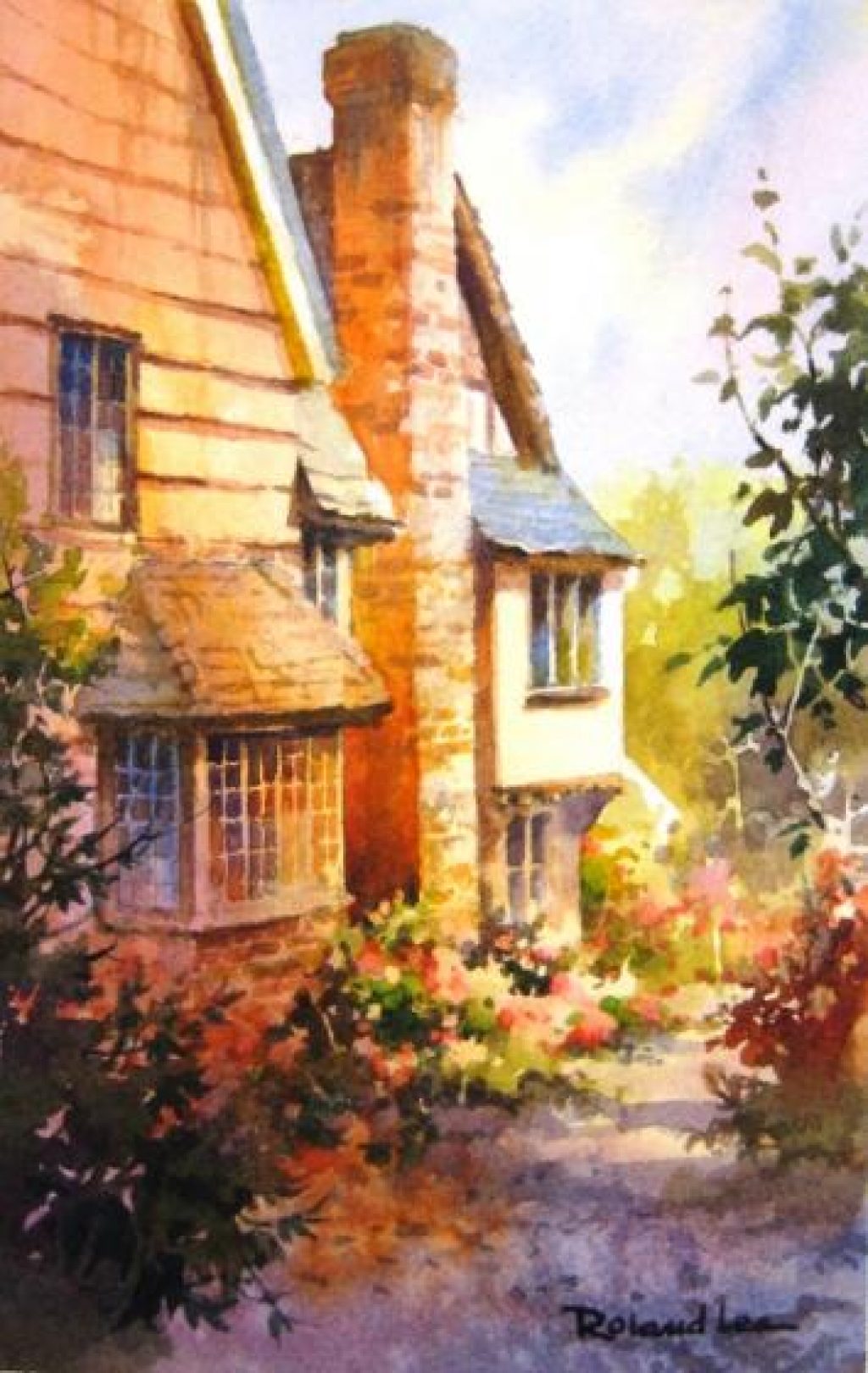
Roland Lee painiting of Village in Kent England
I've taken a little artistic license with this scene, as I so often do. I think residents of the town of Hever in Kent England would recognize the place though. We drove past this tavern on the road from Hever Hotel to Edenbridge often. This was also the pick up point for the Eden Valley walking trail which I took over to Chiddingston Castle.
Click for information on purchasing this painting

Pencil study done on location by Roland Lee in Kent England, done in a hardbound travel sketchbook
I did this sketch of the King Henry VIII Inn and Tavern in the little town of Hever, In Kent England. This sketch inspired the painting "Village of Kent" shown below. We only spent a week in this area, but I had no trouble filling a sketchbook with drawings.
See all the sketchbook drawings of Kent England


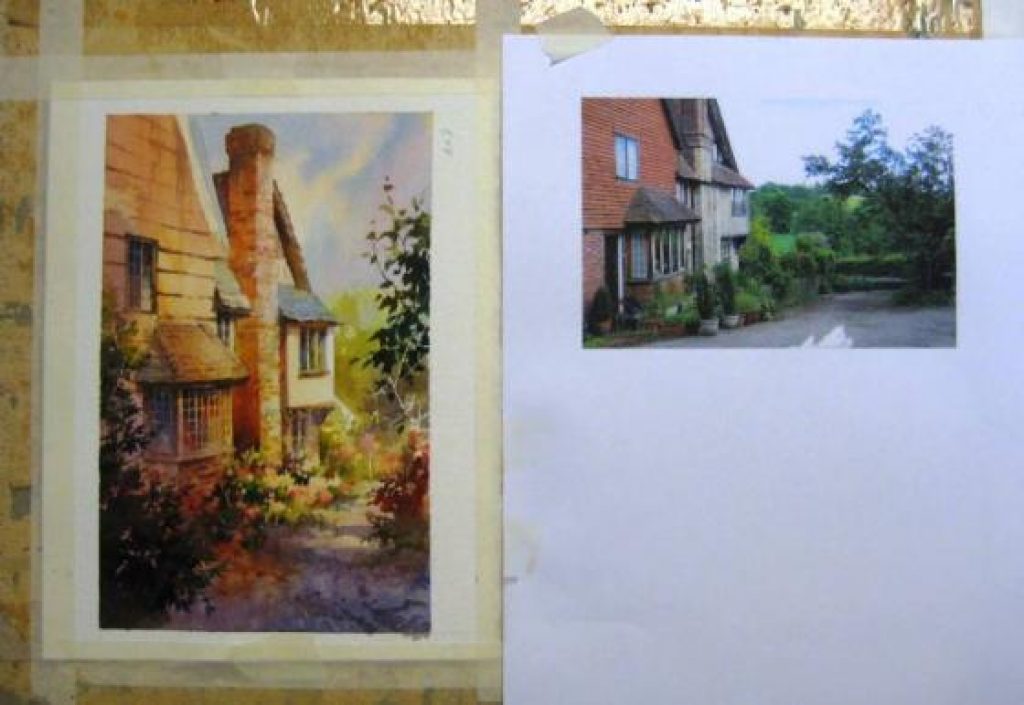
Watercolor painting demonstration by Roland Lee 1. Using the sketchbook drawing done on location in England, along with my digital photo, I work out the design for my painting in a little "thumbnail' value study. A little extra time spent at this point, working out a road map for the painting will save hours of headache later on. The photo at left shows how I work, taping the reference material to my board so I can refer to it as I go. this is a pretty standard procedure for me. With all of this prep work done, and my reference material nearby, I can confidently begin the actual painting.
Watercolor painting demonstration by Roland Lee

2. My painting surface is 140lb. Arches watercolor cold-press paper. It is soaked in the tub then stapled to a stiff backing board. When dry, I apply masking tape around the edges to give a nice clean framing edge on the painting. I often use 300 lb. Arches for big paintings, but in this case I was out of the heavier paper. I like 140 lb. just as well however it doesn't hold moisture as long so I've got to paint more quickly.

Using a 4H pencil I sketch out the painting using light lines, which will be obliterated by the paint when it is applied. If a little pencil shows through in light areas I will lift it off with a kneaded eraser when the painting is complete. I spend a lot of time adjusting the drawing and getting it right at this point. I think drawing well is my biggest strength and there's no question in realist painting it is the very foundation of good painting. Getting the drawing right sometimes takes me a whole day, but it sure makes the rest of the process flow easier.

As always I begin the painting process with the lightest washes. I don't have to be too careful at this point, so I let the pigments mingle and flow together to create texture.The sky is done using a wet-in-wet technique, wetting the surface first, and dropping pigments into it. This creates the soft edges of the clouds.

Watercolor painting demonstration by Roland Lee 3. Now I try to catch the feeling of warm versus cool by working in the center of interest. You can see I am establishing the value relationship of darket darks and lightest lights at this point. the contrast in front of this area must be greater (darker darks against lightest lights) and the distance behind must have less contrast due to aerial perspective. Notice how blue the cast shadow looks on the front window. Once the darks are laid in the blue won't seem so strong (see the finished painting). Core shadows are usually warm due to reflected light while cast shadows are cooler, picking up the blue from the sky.
Watercolor painting demonstration by Roland Lee

4. Okay, now I have to move into the background to define the darkest darks in the distant trees which will never be as dark as the foreground. By using light glazes and wet-in-wet I create the illusion that the trees are off in the distance. This gives depth in the painting. With the distant trees established, I move back to the center of interest and define the flowers and shrubs around the front door. Now I have a pretty good feel for the value relationships and feel confident that the painting is moving in the right direction.

I am using negative painting aorund the foreground leaves so I can use lighter colors there. In my value study I sketched in a figure in front of the distant building. I purposely left that area light so I could paint the figure lighter. Now I sketch in the figure, and decide that it will be a woman in period costume carrrying a basket of something. I carefully place her so the light from the sun will fall on her and the shadow from the tavern will sillhouette her nicely. Remember with watercolor it's always "light against dark--preserve the whites!." However, if you leave too much white it will distort your judgement when laying in the other values. So I better get to work on the foreground and get something laid in there too.

Watercolor painting demonstration by Roland Lee

5. Bringing the painting to completion requires a lot more work -- probably as much time as the whole painting up to this point. All of the foreground tree leaves and flowers are painted using back-painting or negative painting creating the lighter shapes by painting the darks around them. I choose not to use any masking to preserve the lights although there is nothing wrong with that process. I just find it annoying to mess with it.

Notice that I have created an interesting pattern of lights and darks in the street and throw in some reflections for drama. This is a relatively complicated painting, but the hardest part was the research done on location, planning the painting with thumbnail studies, and getting the outline drawing right before I even picked up the brush. After all that, the actual painting process is a cakewalk. I can turn on the music and work on auto pilot. Of course you always hit a few roadblocks as the painting progresses, but with careful planning up front it goes much smoother.

So that's it! I will keep the painting on an easel in my studio for a week or so to look for any problems. I always have my photographer, Frank Carter, shoot some 35 mm slides and several 4 x 5 color transparencies before I send the paintnig off to the framer. That way, once the painting is sold, I still have the image for magazine articles, cards, prints, and archival purposes.

See more Roland Lee Watercolor Painting Techniques and Demonstrations