| Scotney
Tower, Kent England - Watercolor Painting Techniques by Roland Lee |
|
|
We spent a week in the lovely Weald of Kent in Southeastern
England this summer. We visited many castles, and the Scotney Castle
was one of our favorites. The tower was under renovation while we were
there, but that didn't stop me from pulling down the scaffolding and
painting it the way I wanted. The charm in this scene was in the water
reflections and I had fun with it.

The Sketchbook Drawing:
I did this sketch of the old Scotney Tower while visiting Scotney Castle
near turnbridge Wells in Kent. The new castle is nice, but I really
liked the old castle ruins which contained this neat old crumbling tower
surrounded by a picturesque moat. It is an artist's or photographers's
dream for sure.
See
all the sketchbook drawings of Kent England
See
over 40 more painting demonstrations by Roland Lee
|
|
 |
1. Armed with the experience and emotions gained from actually sketching
on location in England, I have a pretty good idea where I want to go
with this painting. As always I begin with a small "thumbnail"
value study working out the design problems. This is especially important
to help me decide where the lights and darks will go, and how I will
direct the viewer's eye. For detai reference I also make a few color
prints from my digital photos shot with my pocket camera (Canon Elph
SD1000).
2. For this painting I'm using Arches 140 lb cold press paper. I soak
it in the tub for about 5 minutes, then staple it to my board. When
dry I tape the edges over the staples giving me a nice clean edge for
mounting and framing.
3. Next, I do a careful line drawing on the watercolor paper with a
4H pencil to help me define where the edges will be. This will help
when I begin laying in dark over light passages.
|

4. I begin painting with very loose, bold washes usually wet-into-wet.
I start with the sky using a combination of Ultramarine blue, Yellow Ochre,
and Cadmium Red Light for the cloud shadows. I use the same in the water
below. While those are drying I drop in some light warm under-glazes on
the tower stone. |
Finished Painting
|
 |
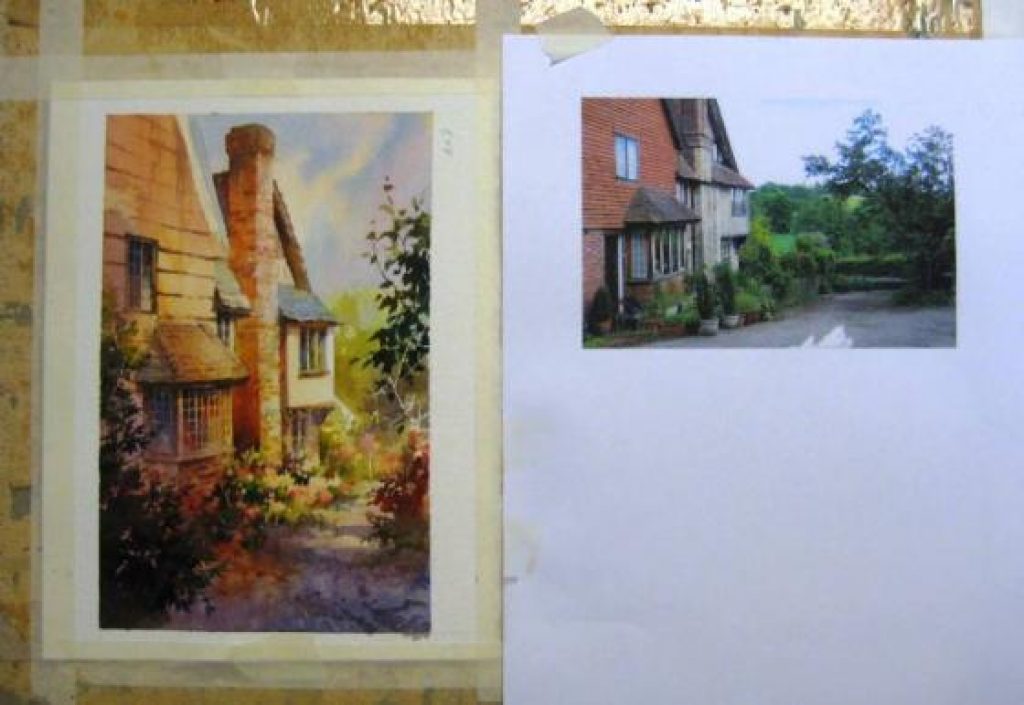
5. This table layout demonstrates my typical studio working situation.
I usually tape my value studies, sketches, and photos to my drawing
table surface so they are readily available for reference. My north
window is to my left, so the light falls over my shoulder. I keep my
paints and water on my left while working on the left side of a big
painting, but move my tabouret to the right side, when working on the
right of a big painting. It's weird but it works for me, and keeps me
from dripping water across my painting surface.
|

6. One of the most important parts of the painting is controlling the
warms in the core shadow and the cools in the cast shadows. Here I start
to establish that relationship and get a feel for where I'm heading with
the rest of the painting. |

Finished Painting |

7. Keeping my value study nearby to keep me on track, I begin to refine
the tower and add the shrubs in the background. This establishes my darkest
darks and lightest lights at my center of interest. |

Finished Painting |

8. Getting increasingly darker with my pigments I continue with the
rest of the middle ground and the foreground water and lily pads. I
grab another photo shot in England for reference as I begin to invent
the foreground. The painting is almost complete, but I still have to
add more detail and sharpen some edges with darker glazes of pigment.
This last part takes longer than the whole painting so far.
|

Finished Painting |
 |
9. After the painting is complete, I put it
on an easel in my studio and study it for a week or so, looking for
problem areas. I want it to be completely resolved before I send it
off to my photographer, Frank Carter, who will make 35mm slides and
several 4x5 transparencies for archive purposes.
"Scotney Tower"
by Roland Lee
Medium: Transparent Watercolor
Image: 20" x 28"
Frame: 30" x 38"
Price framed: $4500
See
over 40 more painting demonstrations by Roland Lee
|
| |
|